
TOUCHING HEARTS - about God, life, love - prayers,love poems, inspirational stories, fashion,cosmetics, travel, jokes , quotes. music.
Saturday, October 26, 2019
Friday, October 25, 2019
THREE RUSSIAN SISTERS, THREE FATES...

This group portrait of the Sukhovo-Kobylin sisters was painted in 1847. And its author is one of the heroines of the picture - the Russian artist Sofya Vasilyevna Sukhovo-Kobylina
Sukhovo-Kobylins is a Russian noble family. Their roots go back to the distant 15th century, when the founder of the branch of interest to us, Ivan Aleksandrovich Sukhovo-Kobylin, became famous for his affairs in Novgorod.
But the girls in the portrait lived much later. Their father, Vasily Alexandrovich Sukhovo-Kobylin, was a member of all the campaigns and general battles with the Napoleonic army. He retired with the rank of colonel of artillery. And he successfully married the daughter of the owner of the Vyksa iron foundry Shepelev.
So the family in which the three girls were brought up was prosperous and respected in Moscow. True, the girls still had a brother - Alexander Sukhovo-Kobylin. The same famous playwright who created the play "Krechinsky's Wedding" and the main person involved in the sensational case in Moscow of the murder of a Parisian fashionista and Moscow merchant, Louise Simon-Demans.
But the story is not about him, but about his sisters: Elizabeth, Sophia and Eudokia. Women are also quite outstanding. True, now more forgotten than their brother.
1. - ELIZAVETA VASILIEVNA
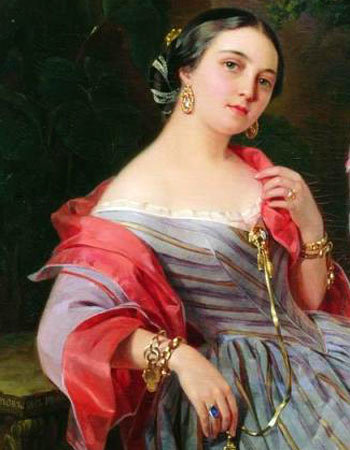
The elder sister, Elizaveta, was born in 1815. Parents, who were known as cultural people in Moscow, sought to give their daughter an excellent upbringing. Her teachers were professors at Moscow University. And among them Nikolai Ivanovich Nadezhdin
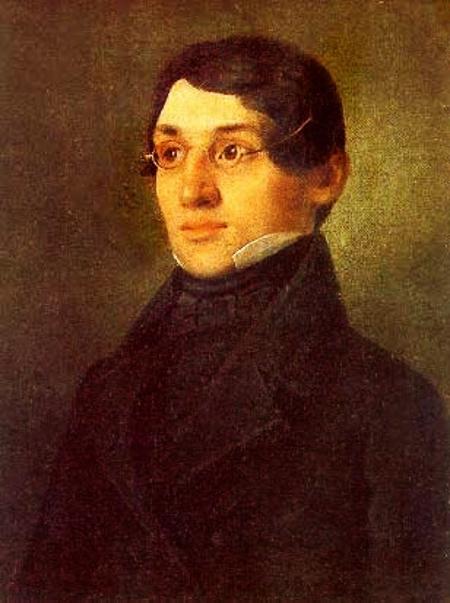
N / X. N.I. Nadezhdin, aprox. 1856
A young, handsome, promising professor made the heart of a young student beat in love. Elizaveta fell in love with him without memory.
Parents could not give consent to marriage. Although a professor, he didn’t come out by birth. After all, Nadezhdin was just the son of a village priest. Quite the wrong party.
Young lovers even planned a secret marriage. Yes, parents quickly sent Lisa abroad, in search of a suitable groom.
He was quickly found. Count Andre of the noble French family Salias de Turnemir, known already since 1264.
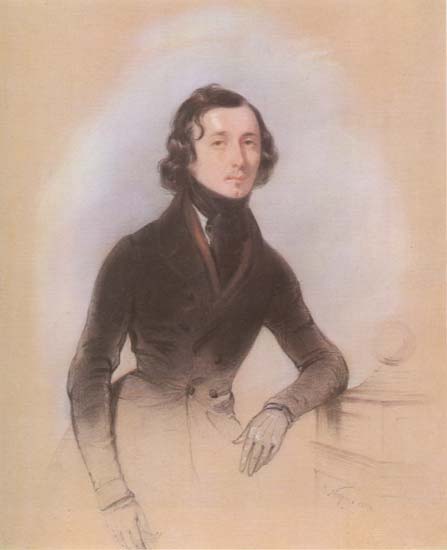
Count Andre Salias de Tournemire
Young spouses settled in Moscow. But the marriage was unsuccessful: the husband squandered all the money and was sent from Russia for a duel. He left alone, leaving his wife with three children virtually left to their own devices.
But Elizaveta Vasilievna did not disappear. She got a good education. She began to write, taking the pseudonym Eugene Tour. Under this name, she went down in history.
But Elizaveta Vasilievna did not disappear. She got a good education. She began to write, taking the pseudonym Eugene Tour. Under this name, she went down in history.
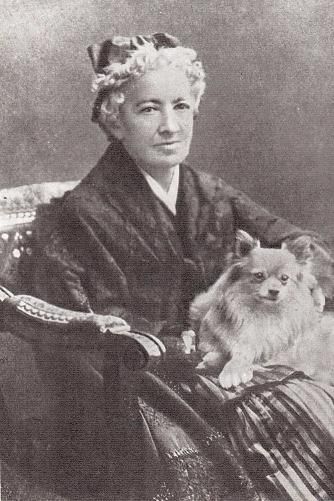
Elizaveta Vasilievna - pen name Eugenia Tour, 1892
Her books were a great success. A. N. Ostrovsky responded very well to her, who welcomed the birth of a "new original talent." He admitted that "the story was written lively and pure Russian", that "the characters are mostly masterfully drawn and true to reality." He pointed to the "only drawback" - the redundancy of long descriptions and reasoning.
Died Eugene Tour at the age of 77 in Warsaw. She was buried in the generic burial vault of the Shepelevs in the Tikhonov Desert monastery near Kaluga.
Died Eugene Tour at the age of 77 in Warsaw. She was buried in the generic burial vault of the Shepelevs in the Tikhonov Desert monastery near Kaluga.

2. - SOFYA VASILIEVNA
Sofya was ten years younger than her sister. But, like her, she received an excellent home education. True, unlike the older sister and brother Alexander, who loved literature, Sophia from an early age preferred painting.
Egor Yegorovich Meyer, a Russian landscape painter, was a teacher of painting Sofya Vasilievna. He quickly recognized the girl as an outstanding artistic talent, backed up by hard work and determination, and later applied for her admission to the St. Petersburg Imperial Academy of Arts. And he never regretted this act. Sophia became the first woman to graduate from the Academy of Arts with a gold medal. After graduating from the Academy, Sofya left for Italy and lived there for ten years.
Egor Yegorovich Meyer, a Russian landscape painter, was a teacher of painting Sofya Vasilievna. He quickly recognized the girl as an outstanding artistic talent, backed up by hard work and determination, and later applied for her admission to the St. Petersburg Imperial Academy of Arts. And he never regretted this act. Sophia became the first woman to graduate from the Academy of Arts with a gold medal. After graduating from the Academy, Sofya left for Italy and lived there for ten years.
Sofya Sukhovo-Kobylina. Self portrait, 1860s
Sofya Vasilievna was a successful artist. But in her personal life, she was unlucky. She has never been married.
Sofya Vasilyevna died at the age of 42. Either in Italy, or in the estate of his father in the Tula province.
Sofya Vasilyevna died at the age of 42. Either in Italy, or in the estate of his father in the Tula province.
3. - EVDOKIA VASILIEVNA
The younger sister, Evdokia, was not famous for her great talents.
In his youth, Nikolai Platonovich Ogarev was in love with her. Darling (as everyone called her) becomes his Fair Lady, and he devotes her the Book of Love.
In his youth, Nikolai Platonovich Ogarev was in love with her. Darling (as everyone called her) becomes his Fair Lady, and he devotes her the Book of Love.
"I breathed the same air over the river,
Where together we sat on the shore
White birches, bending over the water,
They bathed a green leaf and made noise.
Warm and joyful morning greeted us,
And playfully the birds sang. I looked at you "
Where together we sat on the shore
White birches, bending over the water,
They bathed a green leaf and made noise.
Warm and joyful morning greeted us,
And playfully the birds sang. I looked at you "
But Ogarev was married. And there could be no talk of any joint life. Although Darling hoped and waited for 8 years. But Ogarev’s wife did not give a divorce.
Evdokia married Colonel of the Cavalry Guard regiment Mikhail Fedorovich Petrovo-Solovovo. She was 25 years old, he 31.
Evdokia married Colonel of the Cavalry Guard regiment Mikhail Fedorovich Petrovo-Solovovo. She was 25 years old, he 31.
Evdokia Vasilyevna Sukhovo-Kobylina
They had a happy marriage. They lived a long life and gave birth to four sons and a daughter.
Darling always helped everyone who needed her help. In the village, she visited patients, prepared tinctures according to the recipes of traditional medicine, applied bandages and washed the wounds. Darling was one of those people about whom only good memory and pleasant memories remain.
Such different sisters, such different fates ... And each deserves to be remembered.

Thursday, October 24, 2019
SHE'S BEAUTIFUL IN EVERY WAY - by Armand Jacobs
 |
REST IN PEACE - by Tiana Monique Savage
|
Tuesday, October 22, 2019
BLIND VISION - by Mary Mitchell Freedley

Four months of pleasant meetings led to the superficial intimacy that war makes possible, so that I regretted the moving of the hospital and the need of a rest which took me to Paris.
It was there, one dreary evening in late November, that Marston’s name was brought to my dim little apartment, with the request that, if possible, I receive him at once. I was about to sit down to a lonely dinner, and the prospect of his company delighted me. Then he came into the room.
I had last seen him with his friend Esmè as they stood together waving me goodby, the rich, heavy summer sunshine all about them, though something more than a trick of golden light flooded their faces. They were both vitally alive in widely different ways; and yet they strangely seemed to be merely parts of each other. Esmè was an erratic dreamer and seer of visions, and lacked always, even in the unimportant aspects of living, any sense of the personal, the concrete; Marston, in curious contrast, was at all times practical, level headed, full of the luster of life.
The man who stood hesitatingly just inside my door was not Marston, but some stone sculptured image of the gay, glad boy I had known.
The cry I could not choke broke through his terrible immobility, and he spoke, the words sounding unreal, as though he had memorized them for a lesson and rehearsed their very intonation.
“I had to come. I had to tell some one. Then I will go away. I don’t know where; just away. You knew him, knew I loved him. Will you let me tell you? Then I will go away.”
It flashed across my mind in the second before I found words that I had half wondered why Esmè was not with him. It seemed impossible that even their bodies could be separated.
I tried to lead him to the fire and remove his overcoat, but he pushed me from him.
“No, no; don’t touch me. You don’t know, don’t understand. I’ve hunted two weeks trying to find some one, you, any one who knew us to whom I could tell it.” He hesitated, and I waited. His voice took on a curious quality of childlike appeal as he went on: “You know I loved him, know I’d given my life for his, don’t you?” Such phrasing was utterly unlike Marston, but I had seen their friendship in all the glory of its intensity, and I knew no sacrifice would have been too great. I assured him of this, and, remembering my nursing, insisted that he eat, promising to listen to anything he wanted to tell me.
We sat facing each other across the spread table, but neither of us thought of the food after the first few mouthfuls. Twice in the early part of his story I filled his glass with claret, but I cannot recollect his drinking any.
“You must think this strange of me, but I’m not really mad, not now. You see, I’ve lived with the horror ever since they gave me leave, just afterward, trying to find some one I could talk to, some one who would help me go on and finish the things we’d...
“I want to make it all as clear as possible, but I’ve got to tell it my own way, and that isn’t clear.
“Do you remember Brander? We brought him over once or twice. He was a mighty decent sort of fellow. Somehow, though, I hated his being such friends with Esmè, I’d been his only one for so long, you see. Brander was born in India, and somehow Esmè found it out; from hearing him curse in a dialect, I think. They used to talk some unheard-of jargon to each other and enjoyed it.
“Well, one day Brander got smashed in a fight up the lines, along the British front, and was dying. He kept asking for Esmè, calling his name, and when Esmè got word of it, of course he started at once. He took one of the baby Nieuports; they’re fast, and not much of a target from below. He knew the Germans had a masked battery which he’d have to cross.
“I thought I’d like to see him across the enemy country, so I let him get a good start, and then I went up. I lost sight of him in a cloud-bank, and must have flown beyond him, for when I cleared it, he was behind and below me, and coming toward him a big German fighting plane.
“Esmè’s wasn’t a fighting machine, and he should have tried to get away; but he must have seen the German a second after I did and judged it too late. He fired his revolver once, then suddenly seemed to lose control of his machine, and dropped to the level of the other. He must have thought he was done for and made his decision on the instant, counting it better to try to ram the German plane and go down to death together than to take the millionth chance of landing and let the enemy escape. He went head on at the other, and they fell, woven as one machine, just inside the German lines.
“Somehow I got back to our fellows; God knows I wish I hadn’t.
“Every man in our escadrille paid in his own way unconscious tribute to Esmè’s memory. We were awfully and justly proud of him, it’s something to have died for France, but for all of us the fun, the excitement, of the work had gone, been snuffed out. No one turned corkscrew somersaults, Esmè’s great stunt; no one did any of his special tricks any more, not even to show off before the new men.
“We got one of those French immortelle wreaths, tied to it his name and the number of the machine he was driving and dropped it inside their lines. The next morning just at sunrise one of their men flew over our hangars and threw down a stone. Painted on it in German was, ‘Your dead sends thanks’! That’s just like them, brutal, and the last word on their side.
“There’s always work to be done in war, each day’s effort to be made, and the mercy of constant doing helped me. I used to try to forget the fighting and the horrors and go back to the old days.
“Esmè never was like other men in certain ways, all the early things that were unconsciously part of him, I suppose. Even as a little shaver at school he couldn’t be made to understand the ‘why’ of a school-boy’s code. He used to rush headlong into anything and everything, and he generally came out on top. He did the most outrageous things calmly, unthinkingly, and we always made excuses, forgave him, because he was Esmè. At college the men were sometimes rather nasty to him, partly because he couldn’t understand their points of view; and he used to stare a minute and then loll away. He never hurried, perhaps it was his Oriental blood, but he always got there, and could make his very lolling an insult.
“I used to wonder just what it was that made Esmè a great aviator. He was a phenomenally good pilot, although he himself never seemed to realize his remarkable ability. His losing control of his machine that day was inexplicable. But one can’t tell. That high up the slightest thing uncounted on means death. Those days after...
“A month went by. One morning our anti-aircrafters started, and we rushed to see what was doing, and there, just a blot against the unclouded sky, was a plane turning corkscrew somersaults one after another as it came lower and lower. I went mad for a few minutes; only Esmè could turn corkscrews in such a way. I got the captain, and begged him to give orders for our gunners to stop. I must have made him feel the certainty of the wild thing I believed, for he gave the order. It was one of our own machines, in it Esmè, alone, Esmè in the flesh before us, drawn and haggard and old, but Esmè.
“At first he couldn’t speak. We called it strain; perhaps in any other man we shouldn’t, even in our minds, have given it its real name, emotion. He was like a girl. When I put my arm across his shoulders in the old, familiar way, he began to weep silently.
“The fellows were awfully decent and drifted away out of kindness, leaving him alone with me. We went to our tent, the one we’d shared together, and there, after a little while, he told me how it all happened.
“When the two machines fell together in a tangled heap, by some miraculous chance he was unhurt. The German was dead before they landed, he thought.
“Then began the slow, torturing weeks. They kept at him day and night, night and day. They never left him alone, not just guards, but some one always near him whose only business it was to watch him.
“He was a marked man. The Germans knew him to be our best, perhaps the best aviator in all the Allied armies, and they needed him. They tried every sort of hellish torture on him, things one mustn’t think about, to get him to take up one of their photographers over the French trenches, knowing he could do certain notorious tricks which would prove him our man and so render the taking of the necessary pictures comparatively safe. He stuck it out, growing weaker and weaker, until the order came that he was to take up their man in his own machine (they’d used their diabolical skill to reconstruct it), or, Perhaps if it had been an order to shoot him then and there, his courage would have held out; but the other...He was broken, weakened, driven; he gave in.
“They’d taken photographs for miles along the French and British fronts when Esmè noticed the strap which held the camera man was loosened. The man was busy adjusting the films for a new set. Esmè pulled, the strap gave way; he lurched the machine suddenly, and turned it over, his famous somersault trick, and then, without looking back or down, made for our camp.
“Sometimes one forgets to guard one’s expression. I suppose mine showed the horror I couldn’t help feeling. He put his hand out to touch me, but I jumped up and moved away. ‘Marston,’ he said, ‘what’s the matter? Aren’t you glad? There wasn’t any other way but to give in to them. You don’t know what it’s like to feel yourself dying by inches, a little piece more every day, all the time knowing you can’t die enough, and then the chance to be free once more, in the air, clean; you only fifty miles away, and one man between us, one man. What was his life among so many? It’s war, Marston; war.’
“I failed him then. I didn’t stop to think of his overwrought condition, mentally and physically. He simply wasn’t responsible. I had a quick vision of the way the other men would take it, of how I’d try and try to explain Esmè’s action because it was Esmè’s, and all the time I’d know the explanations weren’t any good. We have a code all our own; no rules, no mention ever made of its interpretation, just an aviator’s honor.
“Now, looking back, I can’t think why Esmè’s dropping the man out seemed so hideous. It did, though, and I failed him. He wanted to hear me say the words of welcome he’d counted on, and I just stood and looked at him. He was making queer, whimpering little noises, with his mouth wobbling all over his face, and I watched him. He was suffering, and I looked on.
“After a while the whimperings turned into words, and the words started with giggles. ‘A-aren’t you g-glad, Marston? A..aren’t you g-glad ? A-aren’t you ?’
“I turned on him, all the friendship and the memories of the years behind swept away. I didn’t know what I was saying. I’m not sure now; something about the things one doesn’t do, that it wasn’t war the way we fought it to drop a man thousands of feet who was only doing his duty. It was murder. Over and over I said it, that word murder. He wasn’t my friend; he was a murderer!
“I went out of the tent to escape his staring, pleading eyes, child’s eyes. Even while I was saying the words I knew he didn’t understand. He had done what he thought justifiable, necessary, he wanted to get back to me, and I called him a murderer.
“Once just as I started for the mess to get him something to eat I thought I heard him call my name; but I went on. I needed more time.
“I was gone perhaps ten minutes. When I reëntered the tent it was empty. Esmè was nowhere about, but I didn’t think of looking for him then, for I thought he’d probably joined one of the other men. Later I got worried, and we started a search. He wasn’t in our camp. No one had seen him.
“We waited and wondered. I prayed. Then I found a little scribbled note knocking about among my things.
“We never found any trace even of him or the smallest clue, just the note; that’s all I have left of Esmè. Here it is:
‘You’ve tried to tell me your opinion of the trick I played on an enemy. In any other arm of the service what I did would have gone, been all right, been smart. Isn’t that what you meant, Marston? But with our boys, because we’ve chosen to have a different, a higher standard, because we fight cleanly, what I did was dirty. Well, I understand. You and the other men are different; I’m not, but I can pay. I’m going back. Don’t try to stop me before I reach their lines. You can’t. I go to render unto Cæsar. A life for a life. To give them at least my death, since I can no longer offer even that proudly to France.’
“There has been bravery and heroism in the war, but Esmè went back; he knew to what, yet he went.
“God grant he is dead! I tried to make words express an inexpressible thing. All my life to live out, remembering, knowing I killed my friend!”
Perhaps Marston went on speaking; I don’t know. I only remember the broken stem of his glass, the stain that was spreading slowly over the white cloth, and the dripping, dripping red of his hands.

Monday, October 21, 2019
FALLING LEAVES - by Mariah Christian Kendall
FALL - by René Joseph Rilke
Subscribe to:
Posts (Atom)